
By World Class® Editorial · September 7, 2026 · Corporate Housing
Corporate Housing vs. Extended-Stay Hotels: The Executive's Complete Guide to Furnished Apartments (2026)
For assignments lasting 30 days or more, corporate housing in a furnished apartment costs 35–50% less than a comparable extended-stay hotel suite, while providing significantly more space, a full kitchen, private laundry, and a home-office setup designed for sustained productivity. This guide gives executives, mobility teams, and HR professionals the complete framework to evaluate both options side by side.
1. The Core Question: Hotel or Furnished Apartment?
Every year, companies spend billions on temporary housing for relocating employees, project-based consultants, and executives on extended assignment. The two dominant options are extended-stay hotels and corporate housing through furnished apartment providers. The choice has real financial consequences and most organizations are paying more than they need to.
For assignments of 30 days or longer, furnished corporate apartments outperform extended-stay hotels on every dimension that matters: cost, space, comfort, nutrition, and sustained productivity. This guide examines each dimension with the specificity an executive or mobility manager needs to make a defensible decision.
Extended-stay hotels made sense before the furnished apartment market matured. Today, premium furnished apartment providers like World Class® offer hotel-grade service standards with apartment-grade space and full kitchen functionality, at a price point that eliminates the justification for extended hotel use past the first month.
2. The Cost Case: What the Numbers Actually Show
Monthly Rate Comparison
In most major US markets, a furnished one-bedroom corporate apartment from a premium provider runs $2,500–$4,500 per month all-inclusive. A comparable extended-stay hotel suite — same square footage, same market — runs $4,500–$7,500 per month.
| Cost Factor | Furnished Corporate Apartment | Extended-Stay Hotel Suite |
|---|---|---|
| Base monthly rate (1BR) | $2,500–$4,500 | $4,500–$7,500 |
| Monthly meals | $400–$700 (cooking at home) | $1,200–$2,000 (no real kitchen) |
| Laundry | Included (in-unit) | $60–$120/month extra |
| Parking | Usually included | $150–$300/month extra |
| Total 90-day cost (est.) | $9,000–$16,000 | $17,000–$28,500 |
The blended 90-day cost advantage for corporate housing over an extended-stay hotel ranges from $8,000 to $12,500. That is a material line item that mobility teams and CFOs notice.
The Hidden Cost of No Kitchen
Extended-stay hotels advertise a "kitchenette" that typically includes a mini-refrigerator, a microwave, and perhaps a two-burner cooktop. This is not a functional kitchen for a professional on a 90-day assignment. A breakfast, lunch, and dinner outside the unit costs $60–$80 per day in most US cities. Over 90 days, that is $5,400–$7,200 in dining costs that corporate housing virtually eliminates.
3. Space and Productivity: Why Executives Choose Corporate Housing
Square Footage Matters on Long Assignments
A standard extended-stay hotel suite runs 350–550 square feet. A one-bedroom furnished corporate apartment in Irvine or a comparable market runs 700–1,100 square feet — double the space for less money. For an executive on a 90- or 180-day assignment, that spatial difference is the difference between a productive environment and a stressful, cramped one.
A furnished apartment provides a separate bedroom where work calls cannot be heard from bed, a living room for decompression, a real home-office setup, and a dining table for eating and working. An extended-stay hotel room provides none of that separation.
Dedicated Workspace
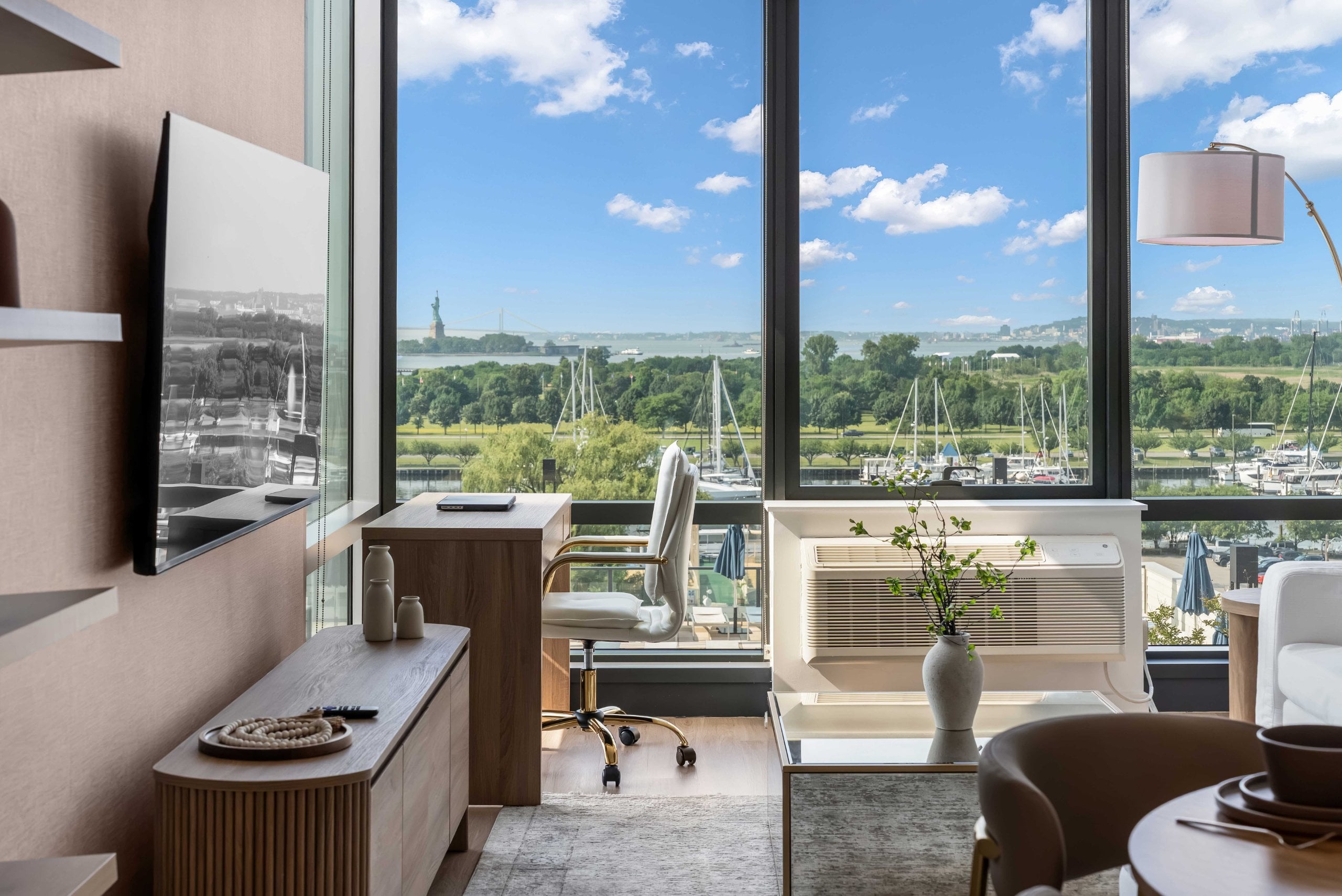
Remote work has made workspace quality critical in temporary housing. An extended-stay hotel typically offers a small desk, hotel Wi-Fi shared across the building (often 10–25 Mbps actual throughput), and no ergonomic chair. A premium furnished corporate apartment includes a full executive desk, ergonomic chair, 300+ Mbps private router, and adequate outlet access for dual-monitor setups. For executives conducting video calls and managing distributed teams, workspace quality directly affects professional output.
4. Who Chooses Corporate Housing and Why
Corporate Mobility Teams and HR
HR and mobility professionals consistently choose furnished corporate apartments in Orange County and other markets over extended-stay hotels for three reasons: per-diem savings, assignee satisfaction scores, and single-invoice billing. A single monthly invoice covering rent, utilities, internet, and parking requires one approval and one expense line. Hotel bills require daily itemization and reconciliation across 90 separate nights.
Assignee satisfaction is a genuine metric in mobility programs. Employees on poor housing assignments underperform, request early returns, and become resistant to future relocation. Companies that house assignees in furnished apartments report higher assignment completion rates and lower early-departure incidents.
Executives on Project-Based Assignments
Consulting partners, investment bankers, litigation attorneys, and technology executives on system implementation assignments all share a common profile: they arrive in a city for 60–120 days, work long hours, and need a base that functions as a real home. Corporate housing solves the recovery problem — the executive comes home to a real kitchen, a real bedroom, and a real living room, rather than a 400-square-foot box.
Corporate Relocation in Transit
Employees permanently relocating often need 60–120 days of temporary housing while searching for a permanent home or waiting for a lease. Furnished apartments provide stability and normalcy that ease the psychological stress of relocation — a factor mobility research consistently links to successful long-term outcomes.
5. Comfort and Amenities: The Full Comparison
- Kitchen: Furnished apartment — full-size stainless appliances, complete cookware, coffee maker, full pantry setup. Hotel — mini-fridge, microwave, two-burner cooktop, no cookware.
- Workspace: Furnished apartment — executive desk, ergonomic chair, private 300+ Mbps router, adequate outlets. Hotel — small desk, shared building Wi-Fi, one or two outlets.
- Laundry: Furnished apartment — in-unit washer/dryer standard. Hotel — coin-operated laundry room, often one floor down.
- Living space: Furnished apartment — separate living room, dining area, 700–1,100 sq ft total. Hotel — combined sleeping/sitting area, 350–550 sq ft.
- Privacy: Housekeeping schedules vary by provider. At World Class®, housekeeping is an optional add-on provided by our in-house team and is charged separately. Hotel — daily entry.
- Storage: Furnished apartment — full closet, dresser, kitchen cabinets. Hotel — limited closet, minimal cabinet space.
6. When Extended-Stay Hotels Still Make Sense
Extended-stay hotels remain the right choice in a narrow set of scenarios. For stays under 25 days, hotel flexibility genuinely outweighs the cost premium. When assignment duration is truly uncertain during the first two to four weeks, nightly cancellation is worth paying for. Zero-notice arrivals — housing needed in under 48 hours — are difficult for furnished apartment providers who typically need 5–10 days of lead time. And in smaller secondary or tertiary markets, furnished apartment supply may not match an executive's quality expectations.
7. How to Evaluate a Corporate Housing Provider
The furnished corporate apartment market includes providers ranging from luxury operators to budget-grade intermediaries who relist Airbnb units with a corporate label. Premium providers like World Class® offer transparent all-inclusive pricing with verified inventory, dedicated account management for mobility teams, and standardized quality across their entire portfolio.
Ask any provider: Is pricing truly all-inclusive (electricity, water, gas, internet, parking)? What is the minimum term and notice period? Is the Wi-Fi private or shared building access? Does the provider directly own or control the inventory? What is the mid-stay issue resolution process?
For executives and HR teams evaluating corporate housing in Irvine or any other market, these questions separate premium providers from aggregators within minutes.
Key Takeaway
For any assignment of 30 days or more in a major US market, corporate housing through a premium furnished apartment provider saves $8,000–$12,500 over 90 days compared to a comparable extended-stay hotel suite, while delivering more than double the square footage, a functional full kitchen, a real home-office setup, and the private environment an executive needs to perform at their best.
Frequently Asked Questions
Is corporate housing cheaper than an extended-stay hotel?
Yes. For stays of 30 days or more, corporate housing typically costs 35–50% less than a comparable extended-stay hotel suite on a total-cost basis, factoring in meals, parking, laundry, and the base monthly rate.
What is corporate housing?
Corporate housing refers to fully furnished apartments rented on a month-to-month basis for business professionals on relocation assignments, project-based work, or other temporary housing needs. Units include all furniture, kitchen items, linens, and utilities under a single monthly invoice.
How long do most executives stay in corporate housing?
The most common stay lengths are 60–90 days for relocation transitional housing and 90–180 days for project-based assignments. The market skews toward the 60–120 day range.
What does corporate housing include?
Premium corporate housing includes fully furnished living space, fully equipped kitchen, all linens and towels, electricity, water, gas, high-speed private internet, parking, and building amenities such as a fitness center. Some providers also include weekly housekeeping. At World Class®, housekeeping is an optional add-on provided by our in-house team and is charged separately.
Can companies bill corporate housing directly to a corporate account?
Yes. Most premium providers offer direct billing with consolidated monthly invoicing, making expense reporting straightforward for mobility teams and finance departments.
How much notice is needed to book corporate housing?
For primary markets, most premium providers need 5–10 business days of lead time. For peak-demand months, booking 2–3 weeks in advance is advisable.
Is corporate housing available in all cities?
Supply is strongest in major US metros including New York, Los Angeles, San Francisco, Chicago, Dallas, Houston, Atlanta, Seattle, Boston, and Washington DC, as well as technology hubs like Irvine, San Jose, and Austin.